EPA Phase 2 Wood Stove Certification: What Every Homeowner Needs to Know
EPA certification affects whether your stove can be permitted, insured, and sold with your home. This guide explains it in plain English — no regulatory jargon.
Since May 15, 2020, all wood stoves sold in the United States must meet the EPA's Phase 2 standard. If your stove was manufactured after that date and purchased new from a dealer, it's almost certainly certified. If your stove is older — or you're buying a home with a wood stove already installed — the certification question becomes important fast.
What Is EPA Certification?
The EPA certifies wood-burning heaters — stoves, inserts, and some fireplaces — by testing them in an accredited laboratory to measure particulate matter (PM2.5) emissions per hour of operation. A stove earns certification when its emissions fall below the EPA's limit, and the manufacturer submits that test data to the EPA.
Think of it like a fuel economy rating for a car: it tells you how clean the stove burns under standardized conditions. Unlike a car's MPG, though, the EPA certification is a legal requirement for sale and increasingly a requirement for installation permits.
The EPA maintains a Certified Wood Heater Database online where you can look up any specific model. It lists the brand, model name, certification date, and emissions rate. We walk through how to use it below.
Phase 1 vs. Phase 2: What Changed
The EPA has run a wood heater certification program since 1988. The current rules represent the second generation of that program:
| Phase | Effective Date | Emissions Limit | Status |
|---|---|---|---|
| Phase 1 | 1990 (original program) | ≤ 7.5 g/hr (catalytic) / ≤ 4.5 g/hr (non-catalytic) | No longer valid for new installations in most jurisdictions |
| Phase 2, Step 1 | May 15, 2020 | ≤ 2.0 g/hr (all types) | Current standard |
| Phase 2, Step 2 | Originally planned for 2023; implementation ongoing | Same 2.0 g/hr limit; updated test method | Current for new certifications |
The practical difference: Phase 2 stoves emit less than half the particulate matter of Phase 1 stoves under the same test conditions. Modern certified stoves — especially those with secondary combustion chambers or catalytic combustors — often test well below 1.0 g/hr, making them significantly cleaner than the limit.
Why Certification Matters (Beyond Clean Air)
EPA certification has practical consequences for homeowners beyond environmental impact:
1. Building Permits
Nearly all building departments that issue solid fuel appliance permits now require the stove to be EPA Phase 2 certified. The inspector looks for the EPA label at inspection. A non-certified stove will fail inspection, which means your installation is not legal and your permit will not be signed off.
2. Homeowner's Insurance
Many insurance companies — particularly in the Pacific Northwest, Colorado, and northeastern states — require wood stoves to be EPA certified as a condition of coverage. Some policies require documentation of the certification number. A fire originating from a non-certified, unpermitted stove installation may result in a denied claim. Always notify your insurer when adding a wood stove and provide the EPA certification number.
3. Home Sales
In several states — most notably Washington, Oregon, and some Colorado jurisdictions — non-EPA certified wood stoves must be removed or permanently decommissioned before a home can be sold. In other states, a non-certified stove may trigger a price negotiation or buyer contingency. Having documentation of your stove's Phase 2 certification makes home sales significantly smoother. See our home sale guide for details by state.
4. Air Quality Burn Bans
Many regions have tiered wood burning restrictions on high air quality alert days. Phase 2 certified stoves are often exempt from voluntary burn bans and face less restrictive rules during mandatory curtailments than non-certified stoves. In some jurisdictions, only certified stoves can legally operate during air quality action days.
How to Check If Your Stove Is EPA Certified
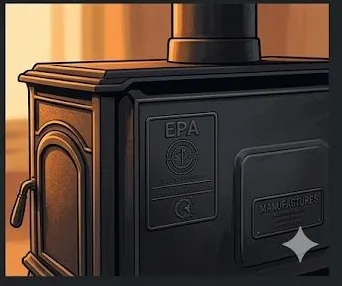
There are three ways to verify your stove's certification status, in order of reliability:
Method 1: Find the Certification Label on the Stove
Every EPA-certified stove has a permanent label affixed to the rear or underside of the appliance. This label includes:
- The EPA certification number
- The phrase "EPA Phase 2 Certified" (or "EPA Certified" on Phase 1 units)
- The certified emission rate in g/hr
- The manufacturer name and model
- The certification date
If the label is missing, illegible, or has been painted over, the stove may fail inspection even if it was originally certified. The label's physical presence is what inspectors verify. Missing labels are a more common inspection failure point than most homeowners expect.
Method 2: Use the EPA Certified Wood Heater Database
The EPA maintains a searchable database at EPA.gov → Certified Wood Heaters (search "EPA certified wood heater database"). You can search by brand name, model name, or certification number to confirm whether a stove appears in the database and which phase it's certified under.
Important: the absence of a model in the database doesn't necessarily mean it wasn't certified — the database has had historical gaps and some older certified models are not fully represented. The physical label on the stove is the authoritative reference.
Method 3: Contact the Manufacturer
If the label is missing or the database lookup is inconclusive, contact the manufacturer directly with the model number (usually found on a data plate inside the door or on the back of the stove). Major manufacturers like Jøtul, Lopi, Regency, Hearthstone, and Vermont Castings maintain certification records and can provide documentation.
Pro tip for home buyers: Before closing on a home with a wood stove, ask the seller to provide the stove's model number and EPA certification documentation. If they can't, photograph the certification label during your home inspection. Non-certified stoves can affect your ability to get insurance and may require removal in some states.
What If My Stove Is Phase 1 Only?
If your stove has only a Phase 1 certification (typically stoves manufactured between 1990 and 2020), here's what that means practically:
- Existing installations: In most states, a Phase 1 stove that was legally installed (with a permit) before the Phase 2 effective date can typically remain in service. You don't have to replace it.
- New installations: You cannot obtain a building permit for a new Phase 1 stove installation in jurisdictions that have adopted Phase 2 requirements. This effectively covers all building departments that have updated their codes since 2020.
- Selling your home: In Washington and Oregon, Phase 1 stoves must be decommissioned at sale. In other states, it depends on local ordinances. Disclose the certification status to buyers.
- Burn ban exemptions: Phase 1 stoves rarely qualify for burn ban exemptions. In regions with frequent air quality events (Pacific Northwest, Colorado Front Range), this limits when you can legally use the stove.
Catalytic vs. Non-Catalytic: Does It Affect Certification?
Both catalytic and non-catalytic stoves can be EPA Phase 2 certified — the distinction is in the technology used to achieve clean combustion, not the certification standard. However, there are practical differences for homeowners:
- Catalytic stoves use a ceramic or metallic combustor to burn off unburned gases. They typically achieve very low emissions (often under 1.0 g/hr) but require regular catalyst maintenance — cleaning and eventual replacement (typically every 3–6 seasons).
- Non-catalytic stoves achieve clean combustion through secondary air injection and secondary burn chambers. They require less maintenance but may test at slightly higher emissions rates. Modern non-cat stoves from reputable manufacturers easily meet Phase 2 standards.
For permitting purposes, both types are treated identically — what matters is whether the specific model appears in the EPA database with a Phase 2 certification.
EPA Certification and Pellet Stoves
Pellet stoves are also subject to EPA certification, but under different test methods (EPA NSPS Subpart AAA). Pellet stoves generally produce very low emissions relative to wood stoves and are almost universally exempt from wood-burning curtailment orders. If you're considering a pellet stove, verify Phase 2 certification the same way — check the label and the EPA database. All pellet stoves manufactured and sold after May 15, 2020 must meet the 2.0 g/hr standard.
Free: Permit Checklist PDF — Includes EPA Documentation Section
Our permit checklist includes a section for recording your stove's EPA certification number, model, and label location for your inspector.
Download Free PDFFrequently Asked Questions
Recommended Tool: Digital Wood Moisture Meter
Burning wet wood is the single biggest driver of creosote buildup and chimney fires. A moisture meter takes 10 seconds per log and tells you definitively whether your firewood is ready to burn. Target: under 20% moisture content. Inspectors and CSIA chimney sweeps recommend testing every cord you receive.
Check Price on Amazon →
As an Amazon Associate, WoodStoveCode earns from qualifying purchases. Price and availability may vary.
— EPA Certification
Recommended Tool: Digital Wood Moisture Meter
Burning wet wood is the single biggest driver of creosote buildup and chimney fires. A moisture meter takes 10 seconds per log and tells you definitively whether your firewood is ready to burn. Target: under 20% moisture content. Inspectors and CSIA chimney sweeps recommend testing every cord you receive.
Check Price on Amazon →As an Amazon Associate, WoodStoveCode earns from qualifying purchases. Price and availability may vary.
Not necessarily. Phase 2 took effect on May 15, 2020, so stoves manufactured before that date were certified under Phase 1 rules (unless the manufacturer proactively sought Phase 2 certification early, which some did). Check the certification label on your stove — it will show the certification phase and date. You can also look up the model in the EPA Certified Wood Heater Database. If it shows a certification date before May 2020, it's likely Phase 1 only.
Yes, in most jurisdictions — provided the certification label is still physically attached and legible. The label is what the inspector verifies, not a receipt. Buy used stoves carefully: inspect the label before purchase, and verify the model in the EPA database. A Phase 2 certified used stove with its label intact can typically be permitted the same as a new stove.
No — certification is necessary but not sufficient. Your inspector will also check clearances, hearth pad, chimney system, stovepipe connections, and CO detector requirements. A Phase 2 certified stove installed with incorrect clearances will still fail inspection. See our inspection guide for the full checklist.
The EPA certification number is the unique identifier assigned to your stove model's certification. It appears on the certification label (the permanent sticker on the rear or underside of the stove). It may also appear on the certification paperwork that came with the stove. If you can't find it, search for your model in the EPA Certified Wood Heater Database — the certification number is listed there for each entry.
Outdoor wood boilers (also called outdoor hydronic heaters) are regulated under a separate EPA standard (NSPS Subpart QQQQ), not the same rules as indoor wood stoves. They do have their own EPA certification requirements and also face stricter local regulations in many areas due to smoke emissions affecting neighbors. This guide focuses on indoor solid fuel appliances; outdoor boilers require separate research into your state and local rules.