Chimney Height Requirements: The 3/2/10 Rule
How high must your wood stove chimney be? The answer comes from NFPA 211 §13.5 — the "3-foot, 2-foot, 10-foot" rule. Here's exactly what it means, why it exists, and when you need to go higher.
Chimney height is not arbitrary. It's calculated to ensure the chimney outlet is high enough to clear roof turbulence zones, create consistent draft, and keep combustion gases away from windows and intake vents. The 3/2/10 rule is the minimum — but it's often not enough for good draft on complex rooflines.
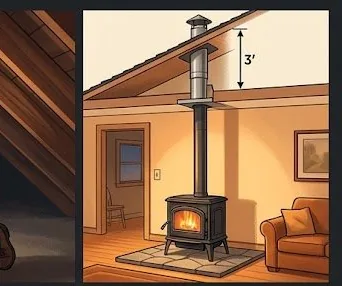
The 3/2/10 Rule — Exactly What It Means
NFPA 211 §13.5.7 and IRC R1003.9 state that the chimney must:
Rule 1 — 3 feet above penetration: Measure from the point where the chimney passes through (or exits at) the highest point of the roof surface. The top of the chimney cap must be at least 3 feet above this point. If your chimney exits a low-slope roof that peaks elsewhere, you measure from the roof surface at the exit point.
Rule 2 — 2 feet above nearby obstructions: Within a 10-foot horizontal radius of the chimney, if any part of the house (ridge, gable, dormer, parapet, adjacent roofline) is higher than the chimney top, the chimney must be extended until it is at least 2 feet above the tallest obstruction within that 10-foot circle.
The practical application: Most installations need to satisfy both rules simultaneously. Both apply — you take the more restrictive (taller) result.
Example: Your chimney exits the roof at 12 feet above grade. The roof ridge is 3 feet away horizontally and 14 feet above grade. Rule 1 says 3 feet above exit point = 15 feet. Rule 2 says 2 feet above ridge (14 ft) = 16 feet, and the ridge is within 10 feet. Rule 2 governs — your chimney top must be at 16 feet minimum.
Why Chimney Height Matters: Draft Physics
The 3/2/10 rule is a minimum for safety — but adequate draft often requires more. Draft is created by the difference in air density between the hot gases inside the chimney and the cooler outside air. A taller chimney creates a longer column of hot gas, generating stronger draft (negative pressure at the firebox). Insufficient chimney height produces weak or reversed draft, which causes smoke spillage into the living space.
Factors that require a chimney taller than the code minimum:
- Steep roof pitch or tall ridge: The 10-foot rule covers horizontal distance but not steep roof turbulence zones. A very tall ridge nearby may create downwash that requires the chimney to extend well above the 2-foot minimum.
- Surrounded by tall trees: Trees within 30 feet can create turbulence zones that extend well above the roof. This is a draft problem, not strictly a code issue, but it's a common complaint from homeowners who pass inspection but experience smoke problems.
- High-altitude installations: At elevations above 5,000 feet (common in Colorado, Utah, New Mexico, Montana), thinner air reduces draft. Chimneys may need to be 2–4 feet taller than the code minimum to achieve adequate draw. Stove manufacturers sometimes specify altitude adjustments.
- Tight, sealed modern homes: Extremely energy-efficient homes with no air infiltration can create negative indoor pressure that fights chimney draft. An outside combustion air supply directly to the stove — which some jurisdictions require for new tight construction — addresses this.
Chimney Height vs. Minimum Vertical Flue Length
Separate from height above the roof, NFPA 211 requires a minimum total vertical flue length of 15 feet from the stove collar to the chimney cap. This ensures sufficient draft regardless of building height. Short chimneys on single-story buildings with low rooflines often need extra sections to meet this minimum even if the 3/2/10 rule is satisfied by a shorter chimney.
Approved Chimney Cap Requirements
Most building departments require a chimney cap. The cap serves three functions: rain exclusion, spark arresting (required in wildfire-prone areas), and critter prevention. Caps must allow adequate exhaust flow — undersized caps with fine mesh screens can restrict draft significantly, especially when screens become clogged with creosote. The standard screen mesh for spark arrestors is ¾-inch galvanized or stainless steel hardware cloth, per NFPA 211 §13.5.9.
Draft problems despite code-compliant height usually come from one of four sources: (1) the home is too tightly sealed and the stove can't draw outside air — try cracking a window near the stove; (2) trees or obstructions beyond 10 feet are creating turbulence at the chimney top — the code radius is a minimum, not a guarantee of good draft; (3) the chimney liner is oversized for the stove — a large-diameter liner on a small stove doesn't develop enough heat to draft properly; (4) the stovepipe horizontal run is too long or not pitched correctly, creating a draft restriction before the chimney.
Pellet stoves typically use direct-vent horizontal terminations or shorter vertical vents rather than full chimneys. The 3/2/10 rule applies to traditional masonry or factory-built chimney systems. Pellet stove termination clearances are governed by the stove's specific listing — typically a minimum of 12 inches above grade and specific distances from windows, doors, and air intakes. Follow the pellet stove's installation manual for venting requirements.
On a steep roof, the "highest point where the chimney passes through the roof" is the uphill edge of the chimney flashing — the highest point of contact between the chimney and the roof surface. The 3-foot measurement starts from that point vertically to the chimney cap. On very steep roofs, this means the chimney extends higher above the ridge than it would on a low-slope roof, which is appropriate since steep roofs create more turbulence.