Wood Stove Clearance Requirements: The Complete Reference Chart
Walls, floors, ceilings, and stovepipe — with and without heat shields. Covers NFPA 211 reduction tables, IRC R1004, and what your building inspector actually measures.
Wood stove clearance requirements are the most commonly misunderstood part of any installation. They are not fixed numbers — they depend on your specific stove's certification and what heat protection, if any, you install between the stove and combustible surfaces. This guide explains the system, gives you the actual NFPA 211 reduction tables, and shows you how to apply them.
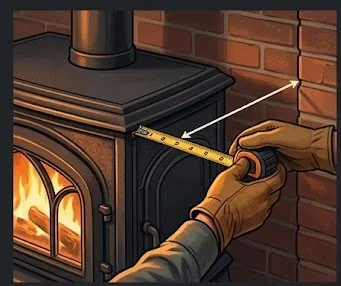
Always start with your stove's certification label. The clearance requirements printed on the label — which the manufacturer derived from lab testing — are the legal standard for your specific unit. The tables in this guide apply to stoves that do not have specific manufacturer clearance reduction allowances. When in doubt, use the more conservative (larger) distance.
The Fundamental Clearance Rule
Under NFPA 211 §8.2 and IRC R1004, the required clearance between a wood stove and any combustible surface is the distance at which the surface temperature, during normal stove operation, does not exceed 117°F above ambient room temperature. Manufacturer testing determines what distance achieves that for each specific stove model — which is why clearances vary between stoves of different designs.
Most freestanding wood stoves without heat shields require 36 inches from unprotected combustible walls (back and sides). But this is the most common manufacturer default — not a universal code requirement. Some stoves require less; some require more. The certification label is the authority.
Clearance Reduction Systems (NFPA 211 Table 8.2.1.2)
NFPA 211 Table 8.2.1.2 defines how much you can reduce clearances when you install approved heat shields between the stove and combustible surfaces. These reductions are widely used to allow stoves to be placed closer to walls in smaller rooms.
| Protection Method | Clearance Reduction Allowed | Minimum Clearance (from 36 in. base) | Air Gap Required |
|---|---|---|---|
| No protection | 0% | 36 in. | N/A |
| 3½ in. solid masonry (brick, block) with 1 in. air space behind | 33% | 24 in. | 1 in. behind shield |
| 28-gauge sheet metal with 1 in. air space behind | 33% | 24 in. | 1 in. behind shield |
| 28-gauge sheet metal on 1 in. mineral wool batt | 50% | 18 in. | None required (insulation provides buffer) |
| 28-gauge sheet metal with 1 in. air space + 28-gauge sheet metal | 66% | 12 in. | 1 in. between layers |
| Listed clearance reduction system (manufacturer-tested) | Up to 67% (system-specific) | As low as 12 in. | Per system instructions |
Critical installation detail: The air gap behind a shield must be open at the top and bottom for convective airflow. A shield sealed at the top and bottom defeats the heat-dissipation purpose of the gap and may not pass inspection.
Floor Protection Requirements (Hearth Pad)
Floor protection prevents heat from the stove body and falling embers from igniting combustible flooring — hardwood, carpet, vinyl, or structural wood subflooring. Requirements come from IRC R1004.4 and NFPA 211 §8.6.
| Situation | Minimum Hearth Pad Extension | Thickness / Material |
|---|---|---|
| Firebox opening < 6 sq ft (most freestanding stoves) | 16 in. in front, 8 in. sides and rear | Non-combustible; listed hearth pad or min. 4 in. brick/stone on ¼ in. non-combustible board |
| Firebox opening ≥ 6 sq ft | 20 in. in front, 12 in. sides and rear | Same material requirements |
| Elevated stove (legs ≥ 6 in.) | Standard extension may be reduced per manufacturer specs | Non-combustible material required regardless |
Inspectors measure the hearth extension from the edge of the firebox opening, not from the stove body. This catches many homeowners off guard — if your hearth pad extends 16 inches from the stove's front face but your firebox door opening is set back 4 inches, the effective extension from the opening is only 12 inches, which fails.
For full guidance on hearth pad materials, thickness, and construction options, see the Hearth Pad Requirements Guide.
Ceiling Clearance
Ceiling clearance is less commonly discussed but equally important. NFPA 211 §8.2.1 requires a minimum of 18 inches between the top of the stove and any combustible ceiling. This applies to the stove body itself, not the stovepipe (stovepipe has its own clearance rules below).
In rooms with low ceilings — a common situation in older farmhouses, cabins, and basement installations — ceiling clearance is one of the first things an installer must verify. If ceiling clearance can't be achieved, the stove cannot legally be installed in that location without a ceiling heat shield that meets NFPA 211 requirements.
Stovepipe Clearance Requirements
The stovepipe connecting the stove to the chimney has its own clearance requirements, separate from the stove body clearances:
| Pipe Type | Clearance to Combustibles | Notes |
|---|---|---|
| Single-wall black stovepipe | 18 in. minimum | Cannot pass through walls, ceilings, or attic spaces |
| Double-wall (listed) stovepipe | 6 in. minimum | Check listing; some list at even lower clearances |
| Class A chimney pipe (through ceiling/roof) | 2 in. from combustibles | Per UL 103 listing; requires listed support box at ceiling |
Stovepipe Run Rules
- Maximum horizontal run: 75% of the vertical chimney height. Longer horizontal runs reduce draft and are a common code violation. Most inspectors want to see horizontal runs under 6 feet.
- Minimum pitch: Horizontal sections must pitch upward toward the chimney at a minimum of ¼ inch per foot to prevent condensate pooling.
- Joint overlap direction: The upper section of pipe must overlap the outside of the lower section — this is the "crimped end down" rule. Reversed joints allow creosote to drip outside the pipe.
- Single-wall pipe length: Horizontal runs in single-wall pipe should not exceed 8 feet under any circumstances, per NFPA 211.
Chimney Clearance: The 2-Inch Rule
Where the chimney passes through walls, ceilings, attic spaces, or floors, a 2-inch clearance from all combustible construction is required under NFPA 211 §13.3 and IRC R1003.2. This is one of the most commonly cited violations during inspections — especially in older installations where the chimney was run close to framing members.
The 2-inch clearance must be maintained the full length of any pass-through, and the thimble or ceiling support box that bridges the ceiling must be a listed component — not just a hole cut around the pipe. For details on chimney height requirements, see the Chimney Height Guide.
Use the Clearance Calculator
Rather than working through these tables manually, use the WoodStoveCode Clearance Calculator. Enter your stove's rated clearance (from the label) and your heat shield type — it outputs all required distances in seconds.
Open the Clearance Calculator →Common Clearance Inspection Failures
Based on the most commonly cited violations in residential solid fuel appliance inspections, these are the clearance issues inspectors find most often:
- Shield air gap not open at top and bottom — often sealed by caulk or trim, defeating the convection cooling the shield provides.
- Hearth pad undersized from firebox opening (not from stove body) — see measurement note above.
- Stovepipe joint direction reversed — crimped end up allows creosote to leak outside the pipe.
- Horizontal run too long or not pitched correctly.
- Single-wall stovepipe used through ceiling or wall — only Class A chimney is permitted for these transitions.
- 2-inch chimney clearance not maintained through attic framing.
Clearance Quick Reference Card — Free PDF
A single-page, printable clearance reference you can keep at the work site. Covers all NFPA 211 table values, stovepipe rules, and the chimney 3/2 height rule.
Download Free PDFFrequently Asked Questions — Clearances
Install an approved heat shield to reduce the required clearance. With a proper two-layer shield (28-gauge sheet metal with 1-inch air space), you can reduce the clearance to 12 inches — a third of the unprotected distance. Alternatively, choose a stove model with a lower manufacturer-listed clearance. Many modern stoves list clearances of 12–18 inches from the factory. Use our Clearance Calculator to find your specific reduction with the shield you plan to install.
Tile itself is non-combustible — but what matters is what's underneath it. If ceramic tile is laid over a wood subfloor with thin-set mortar (a common installation method), the heat from the stove can transmit through the tile, adhesive, and into the wood subfloor below. A proper hearth pad for a wood stove must use materials that provide adequate thermal mass and insulation between the stove and any combustible structural components. A listed hearth pad, or 4 inches of masonry on a non-combustible underlayment, is the correct approach.
Cement board (like HardieBacker or Durock) is non-combustible, but it is not a listed clearance reduction system. It does not qualify for the NFPA 211 clearance reductions described in the table above, which require specific materials and air gaps. Cement board can be used as the substrate for a decorative surface (like tile) on a wall heat shield — but the entire shield assembly must meet the NFPA 211 requirements, including the required air gap behind it.
Corner installations are measured from the nearest combustible surface on each side independently. If your stove is placed in a corner, both the back wall and the side wall must maintain the required clearance. The angular placement doesn't change the required distance to either wall — both must independently meet the clearance requirement. Corner installations often use angled or wrap-around heat shields for this reason.